
Why Are Your Product Photos Not Converting? Common Mistakes and How to Fix Them
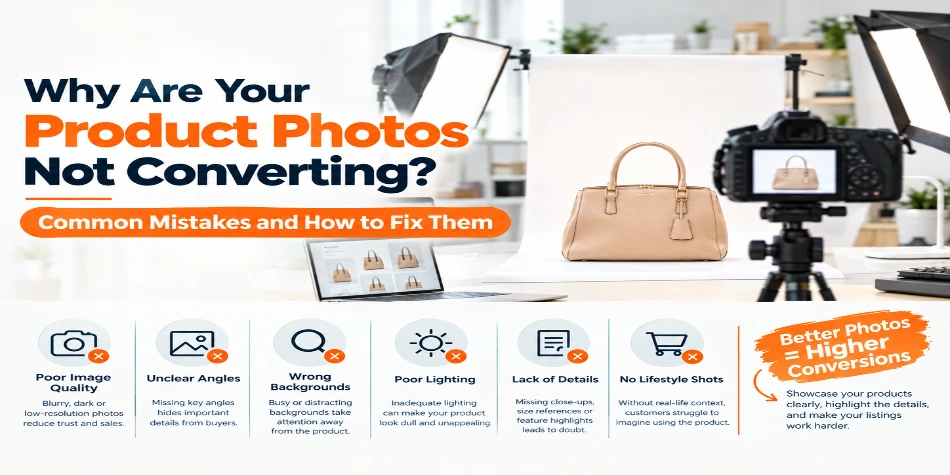
Your product may be excellent. Your pricing may be competitive. Your store may even be getting traffic.
Yet if people are visiting your product page and leaving without buying, take a close look at the images.
So, why are your product photos not converting? In most cases, the problem is not simply that the photos aren't "beautiful" enough. They may be failing to show the product clearly, represent its colour accurately, communicate its size, reveal important details or help shoppers imagine using it.
Online shoppers cannot pick up your product, check its finish, feel the material or compare its size in their hands. Your photographs have to do much of that work visually. If the images leave basic questions unanswered, hesitation starts before the customer even reads the description.
A useful product image should make three things clear: what the product looks like, what it is actually like, and how it fits into the buyer's life.
Reason No. 1: Your Main Image May Be Losing the Click
The first image has a difficult job. It has to communicate the product instantly, often as a small thumbnail on a mobile screen.
If the product occupies too little of the frame, has excessive empty space around it or sits against a distracting background, it can disappear among competing listings.
Try this: view your main image at thumbnail size. Can you identify the product immediately?
Your hero image should have clear framing, controlled lighting and enough visual presence to make the product easy to recognise without unnecessary decoration.
Reason No. 2: Your Colours Don't Look Like the Real Product
A customer ordering a navy shirt should not receive something that looks almost black. A wooden product shouldn't appear noticeably more orange online than it does in real life.
Colour problems often begin during photography rather than editing. Mixed light sources, incorrect white balance and coloured surroundings can introduce unwanted colour casts.
Before publishing, check your images against the actual product under neutral lighting. Editing should improve the photograph, not redesign the product.
Accurate colour is particularly important for fashion, cosmetics, furniture, home décor and products where shade is part of the buying decision.
Reason No. 3: The Lighting Hides More Than It Reveals
Good lighting isn't simply about making a photograph brighter.
Harsh light can create distracting highlights on glossy surfaces. Weak lighting can bury texture and small details in shadow. Reflective products can become especially difficult because they capture everything around them—including the studio, equipment and photographer.
For most commercial products, you want light that reveals the shape, surface, texture and finish without creating distracting hotspots.
Studio reality check: reflective products often need controlled light placement, flags and diffusion rather than simply "more light." That's one reason a phone camera and a professional setup can produce dramatically different results.
Reason No. 4: One Angle Doesn't Tell the Whole Story
Imagine buying a bag from one photograph. You can see the front, but not the back, base, interior or straps.
You would probably hesitate.
Your customers do the same thing.
Depending on the product, consider showing:
-
Front and rear views
-
Side or profile views
-
Open and closed positions
-
Interior compartments
-
Product controls or ports
-
Packaging and included accessories
Don't add angles just to increase the image count. Each photograph should answer a different customer question.
Reason No. 5: Customers Can't Tell the Size
Scale is one of the easiest details to overlook.
A decorative vase photographed by itself may look substantial when it is actually small. A compact electronic accessory can appear much larger than it really is.
Use lifestyle photography, dimensions or familiar surroundings to give shoppers visual context.
For products where physical size matters, a photograph showing the item being held, worn or used can communicate scale far faster than a paragraph of specifications.
Reason No. 6: You're Showing the Product, But Not the Experience
A clean studio image tells the customer what the product looks like. A lifestyle photograph can show them how it fits into their world.
A chair in a room gives context. A jacket on a person communicates fit and styling. A kitchen appliance shown in use explains its purpose almost instantly.
This is especially useful when the product's value depends on how it is used rather than simply how it looks.
Reason No. 7: Important Details Are Missing
Customers zoom in.
They may want to inspect stitching on clothing, the texture of leather, a zipper, a jewellery clasp, the finish of a metal surface or the controls on an electronic product.
A detail photograph gives them that evidence.
For premium or craftsmanship-led products, don't rely entirely on one wide shot. Add close-ups where they genuinely help a buyer assess quality.
Reason No. 8: Your Background Is Competing With the Product
A background should support the photograph, not become the subject.
For marketplace listings and catalogues, clean backgrounds usually make the product easier to inspect. For advertising and brand campaigns, a more creative environment may be appropriate.
The key is to give every image a purpose.
|
Image purpose |
Suitable visual approach |
|
Main marketplace image |
Clean, uncluttered background |
|
Product catalogue |
Consistent studio setup |
|
Lifestyle image |
Real-world environment |
|
Advertising |
Creative, brand-led setting |
|
Detail shot |
Tight crop with controlled lighting |
There isn't one background that works for every situation.
Reason No. 9: Your Catalogue Looks Like It Was Shot by Five Different Brands
This becomes obvious as your product range grows.
One SKU has a warm background. Another is cool. One product sits high in the frame while another sits low. Shadows vary. Colours shift from one batch to another.
Individually, the photographs may look acceptable. Together, they weaken the visual identity of the store.
Consistency requires a repeatable process: fixed camera positions, lighting setups, product placement, framing and editing standards.
That matters even more when you're managing dozens or hundreds of SKUs.
Reason No. 10: Your Images Are Sharp, But Too Heavy for the Web
High-quality photography still needs sensible delivery.
Huge files can slow product pages, particularly for shoppers using mobile networks. Excessive compression, on the other hand, creates visible artefacts and destroys fine detail.
The goal is not simply the highest possible resolution. You want an image that remains sharp at its intended display size while being properly optimised for the website or marketplace.
Always check the current technical requirements of the platform where you sell.
What Should a Complete Product Image Set Include?
A strong product listing doesn't need six photographs that all say the same thing. It needs a visual sequence that removes uncertainty.
|
Image |
What to show |
What it answers |
|
Hero image |
Clear product view |
What am I buying? |
|
Alternate angle |
Side/back/other view |
What does the full product look like? |
|
Detail shot |
Texture, finish or construction |
What is the quality like? |
|
Scale/lifestyle |
Product being used |
How large is it and how does it fit my life? |
|
Feature image |
Important function or component |
What does it actually do? |
|
Packaging |
Contents and presentation |
What will I receive? |
Not every product needs exactly six images. The right number depends on how much visual information the buyer needs before making a decision.
DIY Photography Works—Until It Doesn't
You don't necessarily need a professional studio to photograph two simple products for an early test.
DIY can work when your catalogue is small, the products are straightforward, and you have enough time to maintain consistency.
The equation changes when you have:
-
Dozens or hundreds of SKUs
-
Reflective or transparent products
-
Fashion requiring models
-
Detailed retouching requirements
-
Strict marketplace specifications
-
Multiple product categories
-
Regular catalogue updates
At that point, photography becomes a production operation rather than a weekend task.
The real cost isn't only equipment. It's your team's time, inconsistent results, reshoots and the hours spent preparing and editing every SKU.
How We Approach Product Photography at SnapRich
At SnapRich, we treat commercial photography as a complete production workflow rather than simply pressing a shutter.
We start by understanding what the images need to achieve—marketplace listing, catalogue, website, advertising, social media or a combination of these. From there, we plan the appropriate angles, backgrounds, lighting and styling.
Our Photography Services
We handle:
-
White-background product photography
-
Catalogue photography
-
Creative product photography
-
Lifestyle product photography
-
Industrial photography
-
Corporate photography
For a large catalogue, consistency becomes a major part of our process. We can establish a repeatable visual setup so your products don't look as though they were photographed months apart by different teams.
Serving Businesses Across India
We also work with businesses outside Delhi. Our studio is in Rohini, Delhi, and brands across India can send products to us for photography and post-production.
Bulk Catalogue Photography Pricing
For standardised, high-volume catalogue work, our pricing can start from ₹49 per photo, depending on the scope, product type, styling, number of images and editing requirements.
We prefer to quote according to the actual project rather than hide the important variables behind a generic package.
Before You Send Products for a Photoshoot
A little preparation can save considerable time later.
Before the shoot, make sure you:
-
Finalise the SKU list and variants
-
Clean products thoroughly
-
Remove dust, stickers and temporary packaging
-
Steam or prepare garments
-
Check that all product components are present
-
Identify important features that need close-ups
-
Share marketplace or brand-specific requirements
-
Decide which products need lifestyle or model images
A clear shot list is particularly useful. It prevents the common situation where the shoot is finished, and someone realises an important angle was never photographed.
A Quick Check Before You Blame Your Conversion Rate
Open your five most important product listings and look at the images as a customer would.
Ask yourself:
-
Can I understand the product within a few seconds?
-
Are the colours believable?
-
Can I judge its size?
-
Can I inspect important details?
-
Do the images look consistent with the rest of the catalogue?
-
Does the photography answer the questions that could stop me from buying?
If several answers are "no", your photography deserves attention before you assume the problem is simply traffic or pricing.
Need Professional Product Photography Across India?
At SnapRich, we work with brands that need more than attractive photographs. We help create consistent, commercially useful product imagery across catalogues, marketplaces, websites and marketing campaigns.
Whether you need a small product shoot, bulk catalogue photography, fashion and model images, creative lifestyle photographs or industrial photography, we can plan the production around your requirements.
Share your product catalogue or shoot requirements with us at +91-9560520309, and we'll help you determine the right photography approach, image requirements and project scope.
Frequently Asked Questions
Is professional product photography necessary if my phone camera takes sharp photos?
Sharpness is only one part of a commercial product image. If lighting, colour, reflections, framing and consistency are difficult to control, a technically sharp phone photo can still look unprofessional.
Should I photograph every product in the same way?
Not necessarily. Your core catalogue style should stay consistent, but the shot list can change according to the product, its features and how much visual information a customer needs.
Can I use AI-generated images instead of photographing my actual products?
AI can be useful for backgrounds, concepts and creative visualisation, but it should not replace accurate product photography when customers need to see the real product. Your core product images should represent the actual item honestly.
Is it better to photograph products in-house or use a professional studio?
For a small catalogue or occasional updates, in-house photography can be practical. A studio becomes more useful when you need controlled lighting, consistent results, specialised setups or regular photography at larger volumes.
What should I do if my existing product photos look good but customers still aren't buying?
Don't judge the images only by aesthetics. Check whether they answer practical buying questions about size, features, usage, material and what the customer will actually receive, then compare them with your product-page performance and customer feedback
Trusted by 150+ Brands in India


























What Customers Say About SnapRich
Based on 118 reviews

Tarun Arora

SnapRich truly exceeded our expectations! We hired them for our product shoot and the results were sharp, vibrant, and professionally edited. The team was punctual and easy to work with. Definitely one of the best photography services in India. Highly recommended!
Vivek 007
I had a great experience with SnapRich. Their attention to detail and the way they handled lighting during our corporate shoot was impressive. The photos turned out amazing. If you're looking for a reliable and skilled product photographer, this is the team to go for
Saurabh Pal
SnapRich delivered exactly what we needed. The shoot was organized well, and the quality of the images was top-notch. They’re very professional and understand brand requirements perfectly. One of the best photography services we’ve used so far. Great job!
Neha Joshi
Very happy with the photography service from SnapRich. They’re well-equipped, punctual, and know how to capture products in the best way. The images came out crisp and helped boost our online catalog. A reliable team for product photography in India.
Vikram Saini
Excellent work by the SnapRich team. From setup to final edits, everything was smooth. Their product photography service brought life to our collection. You can tell they’re passionate and skilled. One of the best in the business. Will definitely rebook!
Get in Touch
We’re just a message away – connect with SnapRich!
Book Your FREE Photography Consultation Now!

Our USP
Unbeatable Price
Professional photography starting from ₹49 per photo. No hidden costs. Affordable for all—from startups to big brands.
Fast Delivery
Need it quick? We offer express delivery in 24–72 hours so your listings go live on time, every time.
On-Time, Every Time
We never miss deadlines. Our process ensures timely delivery—smooth from booking to final delivery.
Studio-Grade Quality
15+ years of experience, high-end equipment, and editing precision deliver stunning visuals for any platform.
- Address: A-1/59, 1st Floor, Sector-6, Rohini Delhi-110085
- Email: info@snaprich.in
- Phone: +91-9560520309
Popular Search
- Handbags & Clutches
- Fan & Ventilation
- Bra
- Kurta Palazzo Set
- Kurti
- Lingerie / Bikini
- Panty
- Tops
- Boots
- Formal Shoes
- Bellies Sandals
- Earrings
- Leather Shoes
- Slippers
- Sandals
- Heels
- Electric Vehicles
- Medical & Healthcare
- Construction & Infrastructure
- Female Model
- Corporate Headshot
- Air Cooler
- Lock & handles
- Wall Mount
- Miscellaneous Hardware
- Handbags & Clutches
- Fan & Ventilation
- Bra
- Kurta Palazzo Set
- Kurti
- Lingerie / Bikini
- Panty
- Tops
- Boots
- Formal Shoes
- Bellies Sandals
- Earrings
- Leather Shoes
- Slippers
- Sandals
- Heels
- Electric Vehicles
- Medical & Healthcare
- Construction & Infrastructure
- Female Model
- Corporate Headshot
- Air Cooler
- Lock & handles
- Wall Mount
- Miscellaneous Hardware